
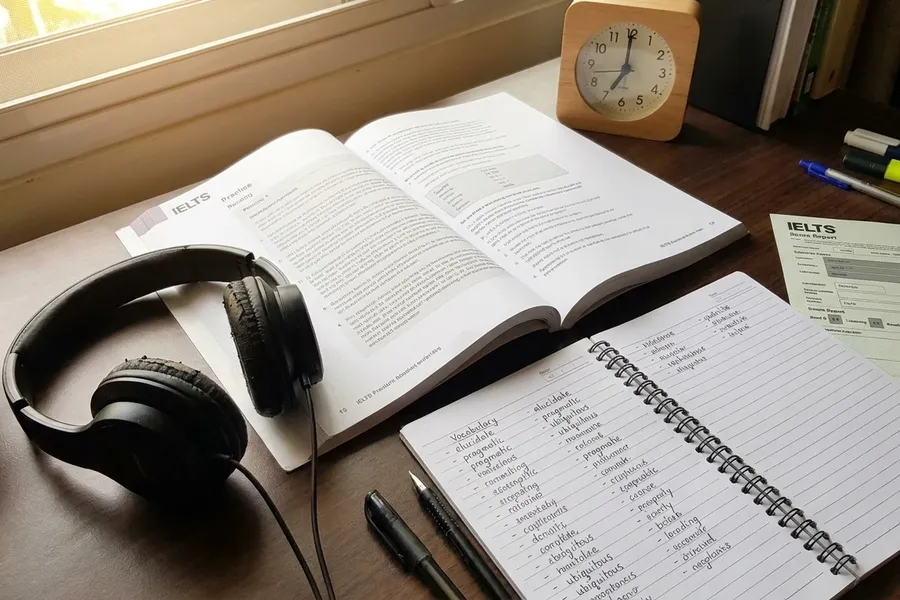
How to Score 8.5+ in IELTS: Section-Wise Strategy That Works
A practical IELTS preparation guide for students targeting Band 8.5 or higher, covering section-wise score targets, Writing and Speaking band expectations, study plan, practice methods and common mistakes.
A Band 8.5 in IELTS is not a reward for studying everything. It comes from knowing exactly where marks are lost and building a preparation plan around those weak points. Listening and Reading need near-perfect accuracy. Writing and Speaking need control, flexibility and fewer examiner-visible mistakes.
The first useful question is not “How many hours should I study?” The better question is: which module is pulling the average down? A student can score 9 in Listening and Reading but still miss 8.5 overall if Writing stays at 7 or 7.5.
What 8.5+ in IELTS really means
IELTS gives separate band scores for Listening, Reading, Writing and Speaking, then averages them for the overall band. The IELTS scoring page describes Band 8 as a very good user and Band 9 as an expert user. So an 8.5 target means the student must operate close to expert level, especially in accuracy and language control.
| Module | 8.5+ Target | What Usually Blocks Students |
|---|---|---|
| Listening | Around 37-39 correct answers out of 40, depending on conversion. | Spelling errors, losing focus in Section 3 or 4, and missing plural/singular forms. |
| Reading | Around 37-39 correct answers in Academic Reading, depending on test difficulty. | Slow passage handling, over-reading, True/False/Not Given confusion and poor keyword matching. |
| Writing | Usually needs both tasks close to Band 8 level or above. | Weak task response, unclear overview, mechanical examples, grammar errors and limited cohesion. |
| Speaking | Needs fluent, flexible, precise speaking with very few visible errors. | Memorised answers, hesitation for grammar, flat pronunciation and weak topic development. |
Listening and Reading are score accelerators because they are objective. Writing and Speaking are score limiters because they are judged through detailed descriptors. A serious 8.5 plan should therefore protect Listening and Reading while actively raising Writing and Speaking.
Know the test before planning practice
The IELTS Academic test format has four sections: Listening for about 30 minutes, Reading for 60 minutes, Writing for 60 minutes and Speaking for 11-14 minutes. British Council also notes that Listening, Reading and Writing are taken on the same day without breaks, while Speaking may happen on the same day or within seven days before or after.
This matters for preparation. The exam is not only a language test; it is also a concentration test. Students targeting 8.5 should practise at least some full Listening-Reading-Writing blocks without long breaks because fatigue changes performance.
Listening: Aim for controlled perfection
Listening is often the easiest module to push toward 8.5 or 9 because every answer has one mark and there is no negative marking. The IDP Listening score page confirms that the test has 40 questions based on four recordings. For a very high band, students must reduce avoidable mistakes rather than learn random tricks.
- Daily drill: Do one section with transcript review, not just answer checking.
- Error log: Separate mistakes into spelling, distraction, paraphrase, number/date, map and plural errors.
- Accent training: Listen to British, Australian, New Zealand and North American speakers.
- Section 3 and 4 focus: Practise academic discussions and lectures because high scorers often lose marks there.
- Final check habit: Verify word limit, spelling, singular/plural and grammar fit before moving on.
Reading: Stop reading like a textbook
IELTS Academic Reading has three long texts and 40 questions. IDP Reading score guidance explains that each correct answer receives one mark and the raw score is converted to a band score. To reach 8.5, students need speed plus evidence-based answering.
The main change is to stop reading the entire passage slowly from the first word. Instead, first read the title, subheadings, first and last lines of paragraphs, and question types. Then locate evidence. In True/False/Not Given, the answer must match the writer’s information, not the student’s outside knowledge.
Writing: Band 8 is built before the first sentence
Writing is where many 8.5 dreams break. The IELTS Writing band descriptor material shows that examiners assess Task Response or Task Achievement, Coherence and Cohesion, Lexical Resource, and Grammatical Range and Accuracy. That means fancy vocabulary alone cannot rescue a weak answer.
- Task 1: Write a clear overview before details; do not list every number mechanically.
- Task 2: Answer all parts of the question and build each body paragraph around one clear idea.
- Vocabulary: Use precise words naturally; avoid memorised phrases that do not fit the topic.
- Grammar: Mix simple and complex sentences, but keep accuracy higher than ambition.
- Review: Leave 3-5 minutes to fix articles, subject-verb agreement, punctuation and repeated words.
For Band 8+, the essay should feel controlled. Examples should be specific enough to support the argument, but not so long that the essay loses direction. A strong student should practise fewer essays with feedback instead of writing many unchecked essays.
Speaking: Sound natural, not rehearsed
IELTS Speaking is marked on fluency and coherence, lexical resource, grammatical range and accuracy, and pronunciation. The public Speaking band descriptors show that Band 8 speakers are fluent with only very occasional repetition or self-correction, while hesitation is mostly content-related rather than grammar-related.
This is why memorised answers are risky. A prepared sentence may sound smooth for one question but collapse when the examiner asks a follow-up. Students should instead prepare idea banks: hometown, study, work, technology, environment, health, education, travel and society.
A practical 8.5 preparation routine
| Practice Block | What To Do | Why It Matters |
|---|---|---|
| Listening accuracy | One recording or section daily, followed by transcript review. | Builds attention to paraphrase, spelling and missed signals. |
| Reading speed | Timed passage practice with question-type error tracking. | Shows whether the issue is speed, vocabulary or logic. |
| Writing feedback | Two Task 2 essays and two Task 1 reports/letters per week with review. | Improves task response and grammar control faster than blind practice. |
| Speaking recording | Record Part 2 answers and Part 3 discussions three times per week. | Reveals hesitation, repetition, pronunciation and weak topic development. |
| Full mock | One full test block weekly once basics are stable. | Builds stamina and shows the real average band. |
Students with less time should not simply do more mock tests. Mock tests diagnose; they do not automatically improve skill. Improvement happens when the student reviews mistakes, understands why the answer was wrong and changes the next attempt.
Common mistakes that keep students below 8.5
- Practising Listening and Reading without analysing wrong answers.
- Writing essays with memorised introductions that do not answer the question.
- Using complex vocabulary without control or topic fit.
- Speaking too fast to look fluent, but losing clarity and pronunciation.
- Ignoring Writing Task 1 because Task 2 feels more important.
- Doing only module-wise practice and never testing exam-day stamina.
Summary
Scoring above 8.5 in IELTS is a precision task. Listening and Reading require very high raw accuracy, while Writing and Speaking require control against official band descriptors. The best preparation plan is not more random practice; it is section-wise error tracking, feedback, timed stamina and deliberate correction.
FAQs
Questions from this guide
Is 8.5 in IELTS possible for Indian students?
Yes. It is possible, but the student needs near-perfect Listening and Reading plus strong Writing and Speaking control. The biggest challenge is usually moving Writing from 7 or 7.5 to 8.
How many correct answers are needed for 8.5 in Listening and Reading?
The exact raw-score conversion can vary by test. As a practical target, students should aim for roughly 37-39 correct answers out of 40 in Listening and Academic Reading practice.
Can I get 8.5 without coaching?
Yes, if the student can diagnose mistakes honestly and get reliable feedback for Writing and Speaking. Self-study works better for Listening and Reading than for Writing feedback.
How long does it take to prepare for 8.5 IELTS?
It depends on the starting level. A student already scoring around 7.5 may need focused correction for a few weeks or months, while a student below 6.5 needs a longer foundation-building plan.